
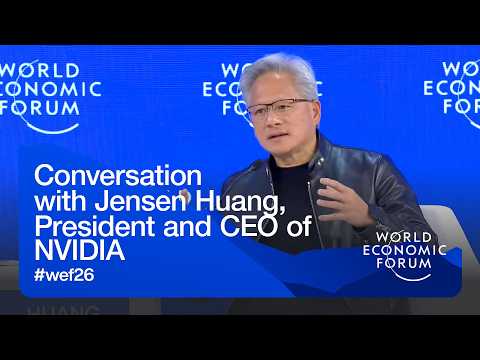
Jensen Huang came to Davos with a diagram, and the diagram is an argument about sequencing.
AI, he tells the Congress Hall, is a five-layer cake. Energy at the bottom, because intelligence is generated in real time and real time costs power. Chips and computing infrastructure above it. Cloud above that. Then the models — which, he notes, is where most people in the room think AI actually is (11:00). And on top, the applications: financial services, healthcare, manufacturing, where the economic benefit lands (11:38).
The framing is clean and largely correct. It is also a case for spending an enormous amount of money on layers one through three before anything arrives at layer five, made by the man who sells layer two.
The claim underneath the diagram
His argument for why this is a genuine platform shift rather than a product cycle is the strongest part of the conversation, and it does not depend on his commercial position.
Software until now was, in his phrase, pre-recorded (8:32). A person wrote the algorithm; the machine executed it against structured data — names, addresses, account numbers arranged into tables and retrieved by query. That constraint shaped fifty years of enterprise computing, and it is why so much organisational effort went into forcing the world into rows and columns.
What changed is that a computer can now process unstructured information and reason about intent (9:14). An image, a recording, a request phrased however the person happened to phrase it. Huang's point is not that this is impressive but that it is categorical: applications that were impossible are now possible, which is the actual test of a platform shift rather than an upgrade.
He extends it one step further. ChatGPT is itself an application — and new applications will be built on top of it, and on top of the other frontier models (7:27). Platforms are things other things get built on, and by that definition the model layer has become one.
The number he wants the room to hear
Larry Fink opens by putting NVIDIA's compounded shareholder return since its 1999 listing at around 37 per cent annually, against BlackRock's 21 per cent over the same period (3:45) — an unusual framing to receive from the head of the world's largest asset manager, and a reminder of which audience this conversation was for.
Huang's own numbers arrive with the infrastructure argument. A few hundred billion dollars have gone into the buildout so far, against trillions he says are required (11:58). His supporting evidence is the supply chain rather than the demand side: a foundry announcing twenty new chip plants, contract manufacturers building thirty new computer plants to feed AI factories (12:40).
That is the more persuasive form of the claim. Order books for fabrication capacity are harder to talk up than customer demand, because someone has to pour concrete.
What the framing does for him
The five-layer cake is not wrong. It is worth noticing what it accomplishes.
By placing economic benefit at the top and making every layer a precondition, it converts infrastructure spending from a bet into a prerequisite. You cannot get the healthcare application without the models; you cannot get the models without the cloud; you cannot get the cloud without the chips; you cannot run any of it without power. Each layer becomes non-optional, and the question of whether the spending at layer two is proportionate to the eventual value at layer five stops being askable, because the layers are presented as a chain rather than as a portfolio.
His Davos framing also differs instructively from the one he gave engineers at GTC two months later. There, the argument was economic and defensive: a gigawatt factory costs forty billion dollars before compute, so architecture determines revenue per watt. Here, for an audience of allocators and heads of state, the argument is structural and expansive — this is a platform shift, the buildout is historic, and the benefit broadens the global economy rather than narrowing it.
Both are recognisably the same person describing the same business. The first is a case for choosing his product. The second is a case for the category existing at the scale he needs it to.
The question the format did not allow
Fink's opening remarks name the interesting problem and then move past it: how to ensure the benefit broadens rather than narrows the global economy.
Nothing in the five-layer cake answers this. The lower three layers are extraordinarily capital-intensive and concentrate among a small number of firms and countries; the top layer is where diffusion would happen, and it is the layer furthest from anyone in the supply chain. Huang's implicit answer is that the applications arrive once the infrastructure exists — which is a statement about capability, not about distribution.
It may still be right. But it is the part of the argument doing the most work, and it is the part with the least evidence behind it, which is a reasonable thing to notice about a keynote delivered to the people writing the cheques.
这些演讲者在其他会议上的发言: Nadella's Argument: Enterprises Stop Consuming the Frontier and Join It · Jensen Huang's GTC 2026 Keynote: Vera Rubin, the Groq Deal and the Inference Inflection
关键数据
- 37% vs 21%
- NVIDIA's compounded annual shareholder return since its 1999 listing against BlackRock's, as cited by Fink 3:45
- a few hundred billion dollars
- spent on the AI buildout so far, against the trillions Huang says are required 11:58
- 20 chip plants, 30 computer plants
- announced fabrication and assembly capacity he offers as supply-side evidence 12:40
演讲章节
关键要点
- 01
His five-layer framing runs energy, chips, cloud, models and applications — with the observation that most of the room believes AI is the models layer. 11:00
- 02
Software until now was pre-recorded: a person wrote the algorithm and the machine executed it against structured tables, which shaped fifty years of enterprise computing. 8:32
- 03
The categorical change is a machine that processes unstructured input and reasons about intent, making previously impossible applications possible rather than existing ones faster. 9:14
- 04
He treats the frontier models as platforms in their own right, on the grounds that new applications are now being built on top of them. 7:27
- 05
Economic benefit lands at the application layer, but every layer beneath it is presented as a precondition rather than as a competing use of capital. 11:38
- 06
His supply-side evidence is harder to inflate than demand: twenty new chip plants and thirty new computer plants announced by manufacturers. 12:40
- 07
Fink opens by putting NVIDIA's compounded return since 1999 at roughly 37 per cent annually against BlackRock's 21 per cent — a framing that signals which audience this was for. 3:45
提及的实体
相关演讲

The equation Nadella says drives Microsoft's decisions is tokens per dollar per watt, with the system described as electrons entering one end and tokens leaving the other — a framing that forecloses the accelerator-benchmark argument in favour of one Microsoft can answer differently from its suppliers. Two claims sit beside each other. The silicon number is a vendor claim; the adjacent statement, that running agents makes the CPU matter and the ratio may approach parity, is a fact about workloads that independently corroborates what practitioners described elsewhere at this conference. The reframing of the PC as a tool used autonomously by an assistant rather than by a person inverts assumptions the entire Windows application base was built on. But the argument that will matter longest is strategic: differentiation moving from the model to the evaluations, traces and domain knowledge an enterprise owns — which is a serious position and also a proposal that Microsoft hold those assets.

Jensen Huang used NVIDIA's 2026 GTC keynote to argue that AI has crossed an inference inflection: models that once only generated text now reason and act, and each step multiplies the compute a single task consumes. He put NVIDIA's forward demand visibility above one trillion dollars through 2027, then spent much of the keynote explaining why that is a factory-economics claim rather than a chip claim — a gigawatt of AI factory costs roughly forty billion dollars before any compute is installed, so throughput per watt is what determines revenue. The technical centrepiece was the Vera Rubin platform; the strategic surprise was NVIDIA absorbing the Groq team to cover the low-latency decode that NVLink alone cannot reach. He closed on two extensions of the agentic thesis: OpenClaw as an emerging operating system for agents, hardened for enterprises as NemoClaw, and physical AI, where four new robotaxi partners add roughly eighteen million vehicles a year.

Harari spends most of his address establishing terms before asking the question he came to ask. His preliminary work is to dismantle the word tool: a knife's use is decided by whoever holds it, whereas what is arriving decides for itself, and can also invent new kinds of knives. From there he argues that anything constituted by words — law, books, text-centred religion — is exposed, while drawing a firm line at feeling, where he says there is no evidence at all. The structural claim is that the ancient tension between letter and spirit has always run inside humanity and is about to be externalised between humans and the new masters of words. Only then does he arrive at personhood, and his handling is precise: corporations, New Zealand rivers and Indian deities hold legal personhood safely because the decisions are made by humans behind the container. An entity that decides for itself ends that arrangement. He does not answer the question; he tells the room it is coming.

A year after their first joint appearance, the heads of Anthropic and Google DeepMind returned to a shared stage and disagreed mainly about speed. Amodei held to a horizon of one to two years for systems that outperform humans across most cognitive work, resting the claim on a self-improvement loop that runs through code; Hassabis kept to the end of the decade, arguing that verifiable domains like coding and mathematics automate far earlier than natural science, and that the capacity to pose a new question rather than answer an existing one is still missing. The exchange is most useful where they converge: both accept the loop is the variable that decides everything, both are sceptical of doomerism without dismissing the risk, and both want more time than the competitive dynamic allows. Amodei's chip-export argument and Hassabis's call for minimum international safety standards are the two concrete policy asks.

A show of hands opens the session: nearly everyone has piloted, far fewer have scaled, and everyone who scaled hit problems they did not anticipate. What makes the panel useful is where the four answers do not point. None of the executives — running a healthcare manufacturer, a payments network, an energy producer and a consultancy — blames model capability, cost or data infrastructure. All four describe an organisational constraint. McInerney's account is the sharpest and is an account of failure: eighteen months of executive advocacy and democratised model access produced nothing, until three hundred senior leaders were put in a room for two days and made to build agents themselves. Jakobs supplies the mechanism worth copying, measuring returned clinician time against the three to seven minutes a patient currently receives rather than against cost. Nasser rejects the premise that acquiring compute produces value, and locates returns in operations rather than in the back-office functions most organisations automate first.

The distinction in this session that deserves to travel is a two-word change: the model is moving from an attention economy to an attachment economy. That changes what is measured and what regulation would have to address, because attention competes for time while attachment competes for relationship, and the two produce different products from identical technology. Attention is finite in a way people notice; attachment produces reliance that feels like preference, which makes it harder to regulate for the same reason it is harder to notice. The supporting argument is about incentives rather than intent: earlier engagement produces more data and longer relationships. The regulatory proposal — measuring well-being outcomes rather than asking for safety by design — identifies the right target without solving the measurement problem that made regulators settle for a floor in the first place.