

The phrase worth extracting from this address is six words long: cooperating with like-minded democracies so as not to be forced to choose between hegemons and hyperscalers (14:24).
It is a compact statement of a problem most governments have not yet named. The conventional framing of technology sovereignty is about states — which bloc's standards, whose chips, whose rules. This framing puts corporate platforms in the same sentence as state powers, and treats dependence on either as the same kind of vulnerability.
Why pairing them is the interesting move
A middle power worried about being caught between two great powers has a well-understood playbook: diversify partners, avoid exclusive commitments, keep options open.
A country dependent on a small number of compute providers faces something structurally similar and not usually described that way. The provider is not a state, has no diplomatic obligations, and answers to shareholders — but the dependency has the same shape, because switching is expensive and the supplier's decisions are not subject to the dependent country's politics.
Naming both as things to avoid being forced to choose between is a claim that the second dependency now matters as much as the first. Whether that is right is arguable. That it is being said from this podium, by a head of government, is the news.
The proposed response is cooperation among like-minded democracies rather than domestic substitution — which is realistic. No middle power builds an alternative alone, and a coalition might collectively be a large enough customer to have terms rather than take them.
The organising idea underneath
The speech gives that approach a name: variable geometry — different coalitions for different issues, based on shared values and interests rather than fixed membership.
The examples are specific. A core role in the coalition supporting Ukraine. Alignment with Denmark and Greenland on Arctic sovereignty. Efforts to build a bridge between the Trans-Pacific agreement and the European Union that would create a trading bloc of 1.5 billion people (13:59). Buyers' clubs anchored in the G7 so that critical mineral supply can diversify away from concentration (14:18).
The consistent logic is that permanent institutions are slow and issue coalitions are fast, so you form the coalition that can act on the specific thing. It is explicitly described as not naive multilateralism and not reliance on existing institutions.
The obvious objection is that a web of overlapping partial coalitions is precisely how the postwar institutions began, and they became slow by accumulating members and obligations. Variable geometry is fast because it is new, and the speech does not address what keeps it fast.
The argument that connects everything
The most substantive claim is about the relationship between economic exposure and foreign policy: diversification is a material foundation for honest foreign policy, because a country earns the right to principled positions by reducing its vulnerability to retaliation (17:46).
That is a more useful formulation than the usual sovereignty language. It does not claim that a country should be self-sufficient, which no medium-sized economy can be. It claims that concentration of dependence is what converts into leverage — and that the fix is spreading the dependence rather than eliminating it.
Applied back to the AI point, the implication is clear. A country whose compute, models and cloud infrastructure come from a small number of suppliers has limited room to take positions those suppliers dislike. Diversifying that dependency is the same policy as diversifying trade, applied to a different input.
The domestic side, and the number to watch
The programme described is large: fast-tracking around a trillion dollars of investment in energy, AI, critical minerals and new trade corridors (12:04), alongside doubling defence spending by the end of the decade in ways intended to build domestic industry.
Set against the assets claimed — energy resources, critical mineral reserves, a highly educated population, and pension funds among the world's largest and most sophisticated investors (17:46) — the argument is that the capital and the inputs are already domestic, and the constraint is deployment rather than availability.
The evidence offered for the approach working so far is narrower: more jobs created since the tariffs were imposed than in the United States in absolute terms (20:24), and a network of trade agreements covering 1.4 billion people (21:46).
The first is a real comparison and a short window. The second is the number that matters for the argument, because coverage of agreements is the direct measure of whether the diversification strategy is producing anything. It is the figure to check in a year, and it is the one that would falsify the whole approach if it stopped moving.
关键数据
演讲章节
关键要点
- 01
On AI the stated goal is cooperation among like-minded democracies so as not to be forced to choose between hegemons and hyperscalers. 14:24
- 02
A bridge between the Trans-Pacific agreement and the European Union would create a trading bloc of 1.5 billion people. 13:59
- 03
Buyers' clubs anchored in the G7 are proposed so critical mineral supply can diversify away from concentration. 14:18
- 04
Spreading trade and investment abroad is presented as what makes a principled stand affordable, by lowering how much a retaliating partner can hurt you. 17:46
- 05
The evidence offered is a trade agreement network covering 1.4 billion people, which is the figure that would falsify the strategy if it stalled. 21:46
提及的实体
相关演讲
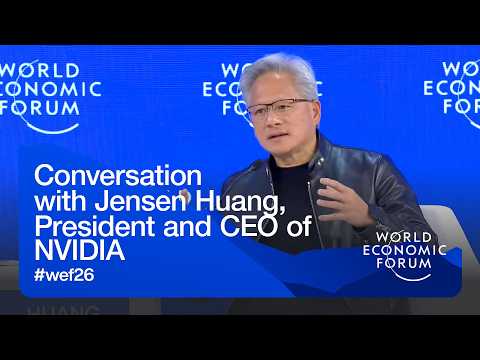
Huang brings a diagram to Davos: AI as a five-layer cake running energy, chips, cloud, models, applications — with economic benefit landing at the top and every layer below it a precondition. His argument for why this is a genuine platform shift rather than a product cycle is the strongest part, and it does not rest on his commercial position: software was pre-recorded and worked on structured data, whereas a machine that reasons about unstructured input and inferred intent makes previously impossible applications possible. What the framing accomplishes is worth noticing separately. By presenting the layers as a chain rather than a portfolio, it converts infrastructure spending from a bet into a prerequisite, and the question of proportion between layer-two spending and layer-five value stops being askable. Read against the GTC keynote two months later, the same business gets two framings: one a case for choosing his product, the other a case for the category existing at the scale he needs.

Harari spends most of his address establishing terms before asking the question he came to ask. His preliminary work is to dismantle the word tool: a knife's use is decided by whoever holds it, whereas what is arriving decides for itself, and can also invent new kinds of knives. From there he argues that anything constituted by words — law, books, text-centred religion — is exposed, while drawing a firm line at feeling, where he says there is no evidence at all. The structural claim is that the ancient tension between letter and spirit has always run inside humanity and is about to be externalised between humans and the new masters of words. Only then does he arrive at personhood, and his handling is precise: corporations, New Zealand rivers and Indian deities hold legal personhood safely because the decisions are made by humans behind the container. An entity that decides for itself ends that arrangement. He does not answer the question; he tells the room it is coming.

A show of hands opens the session: nearly everyone has piloted, far fewer have scaled, and everyone who scaled hit problems they did not anticipate. What makes the panel useful is where the four answers do not point. None of the executives — running a healthcare manufacturer, a payments network, an energy producer and a consultancy — blames model capability, cost or data infrastructure. All four describe an organisational constraint. McInerney's account is the sharpest and is an account of failure: eighteen months of executive advocacy and democratised model access produced nothing, until three hundred senior leaders were put in a room for two days and made to build agents themselves. Jakobs supplies the mechanism worth copying, measuring returned clinician time against the three to seven minutes a patient currently receives rather than against cost. Nasser rejects the premise that acquiring compute produces value, and locates returns in operations rather than in the back-office functions most organisations automate first.

A year after their first joint appearance, the heads of Anthropic and Google DeepMind returned to a shared stage and disagreed mainly about speed. Amodei held to a horizon of one to two years for systems that outperform humans across most cognitive work, resting the claim on a self-improvement loop that runs through code; Hassabis kept to the end of the decade, arguing that verifiable domains like coding and mathematics automate far earlier than natural science, and that the capacity to pose a new question rather than answer an existing one is still missing. The exchange is most useful where they converge: both accept the loop is the variable that decides everything, both are sceptical of doomerism without dismissing the risk, and both want more time than the competitive dynamic allows. Amodei's chip-export argument and Hassabis's call for minimum international safety standards are the two concrete policy asks.

The distinction in this session that deserves to travel is a two-word change: the model is moving from an attention economy to an attachment economy. That changes what is measured and what regulation would have to address, because attention competes for time while attachment competes for relationship, and the two produce different products from identical technology. Attention is finite in a way people notice; attachment produces reliance that feels like preference, which makes it harder to regulate for the same reason it is harder to notice. The supporting argument is about incentives rather than intent: earlier engagement produces more data and longer relationships. The regulatory proposal — measuring well-being outcomes rather than asking for safety by design — identifies the right target without solving the measurement problem that made regulators settle for a floor in the first place.

The most useful sentence is a diagnosis of how clients are getting it wrong: they see a cost opportunity rather than a revenue one. That framing decides everything downstream, because an organisation treating AI as cost reduction measures success by what disappears and arrives at a smaller version of what it already was. The market number offered — seventeen per cent index growth in 2025 that nobody foresaw — is deployed against bubble anxiety and argues in both directions, since unforecast gains are poor evidence for confidence in any current consensus. The panel then locates the real source of instability outside technology entirely, in three geopolitical situations generating enough uncertainty to dominate planning, which is a corrective worth taking seriously at a technology conference. Their closing question about thriving across multiple futures is correct and sits uneasily beside the cost framing they diagnosed at the start.