议题

AI Infrastructure

28
演讲
50
嘉宾
30
机构

最新演讲

Bottlenecks Hide Other Bottlenecks

The most useful admission here is that intuition is what fails: the team stepped back because performance work was not going as fast as they wanted and found their instincts were leading them astray. The mechanism is that bottlenecks hide others — you remove the visible one and uncover a worse problem that was masked behind it, which is why a correct fix so often moves no numbers. Their answer is to survey broadly before drilling in, explicitly checking whether the processor back end is worse, finding it is not, and setting it aside. The diagnostic figure is instructions per cycle averaging below one against hardware capable of eight to twelve, which reframes the problem from slow code to an idle processor. Every fix that follows is about memory layout rather than logic, and returns nearly twenty per cent more throughput from configuration alone.

AWS re:Invent

Two Million Cores, and Back to Zero in Four Hours

The number that matters here is not a benchmark but a shape: scaling up to 2.2 million virtual cores and back down to zero across four hours. Peak capacity has never been the hard part of scientific computing, because institutions have built large clusters for decades — the difficulty was that the cluster was sized for the peak and idle the rest of the year. Returning to zero removes that calculation, which suits genomics precisely, since analysis is bursty by nature. The acceleration claim is a change in the kind of activity rather than a productivity gain: eight hours means return tomorrow, thirty-five minutes means adjust and run again. The hardware explanation is unusually clear that cores per chip rather than total core count drives the improvement, and two operational findings — provisioning cost and a storage benchmark that showed no difference — are more portable than the hardware itself.

AWS re:Invent

Everything Here Is About Moving a Kernel Across One Line

Everything in this session is downstream of one diagram: an accelerator has finite memory bandwidth and finite compute throughput, and where a workload sits between them is decided by how many operations it performs per byte read. Landing memory-bound means expensive compute units idle while data arrives, and every technique demonstrated exists to move a kernel across that line. The natural objection is that a compiler should handle this, and the implicit answer is that it cannot, because the decision depends on tensor shapes whose relative importance a general compiler cannot infer. The kernel structure repeats identically for every operation — allocate on-chip, copy down, compute, copy back — which is an explicit data-movement schedule with arithmetic attached, and which ties the code to one memory hierarchy. Two practices are worth stealing regardless of hardware: measuring on a few layers rather than a whole model, and verifying numerical equivalence rather than assuming it.

AWS re:Invent

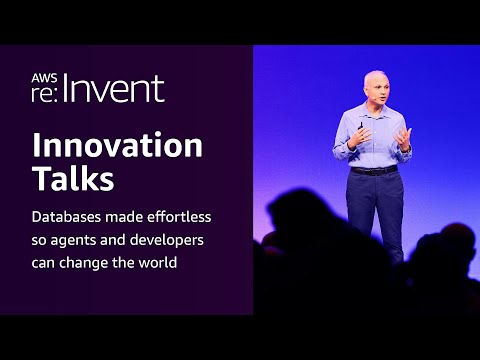
When Nothing on the Other End of the Connection Is a Person

The forecast this session opens with is over 1.3 billion AI agents in production by 2028, offered with the suggestion that it may be conservative. Treated as a claim about connection counts rather than a market prediction it becomes useful: the thing on the other end of a database connection is increasingly something that decided moments ago it needed storage. Provisioning latency, a background annoyance for twenty years, becomes a hard dependency in an automated build, and maintenance that presupposes a human operator who scheduled a window no longer fits. The customer migration that grounds the abstraction — eight engineers moving four and a half petabytes in under 120 days — is credible mainly because it ran between closely related products, which is the honest caveat. The optimiser improvement buried at the end matters more than it looks, because an agent writing its own queries has hand-tuned none of them.

AWS re:Invent

如何引用本页

复制这份有来源支持的实体档案的稳定引用。