

Editorial Policy
How OnlineSummit handles sources, quotations, AI summaries, editorial review and corrections, and what to check before citing a talk.
OnlineSummit's editorial policy requires traceable sources, faithful attribution and clear disclosure of AI assistance. A source badge establishes provenance; it does not independently prove a speaker's claim. Use these rules to check a passage before citing it, or report a correction when the record falls short.
Sourcing and quotations
We require factual claims, statistics and forecasts to link to the material that supports them, with a timestamp or page number where applicable. An official recording, transcript, slide or report must support the specific passage being cited. An event homepage alone cannot establish what someone said.
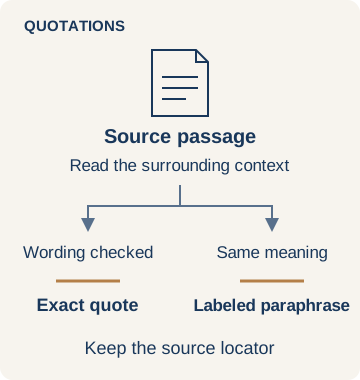
Check the passage in context before choosing how to reproduce it. A paraphrase still needs attribution and a source location.
We publish a verbatim quotation only when its wording can be checked against a transcript or clear audio. If exact wording cannot be established, use a clearly labeled paraphrase that preserves the speaker's meaning and uncertainty. Translated passages should be identified as translations, with access to the original material.
Numbers must retain the source's unit, period, comparison and stated conditions. Missing conditions remain gaps to resolve, rather than assumptions to add. We credit speakers with their role and organization at the time of the talk, and verify identity before merging or linking records for people who share a name.
The methodology explains source types, locators and the checks to make before using a talk in research.
Opinions, forecasts and company claims
We attribute a statement to its speaker and preserve what kind of statement it is. An opinion remains an opinion; a forecast remains a prediction about an outcome. Promotional assertions belong to the speaker or company making them. An official source can establish that a claim was made without independently establishing its accuracy.
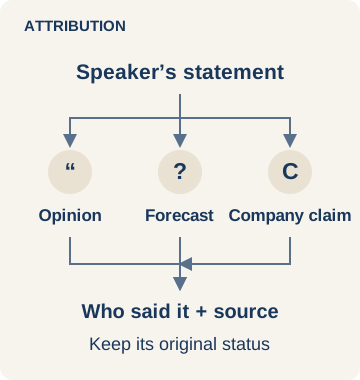
Attribution travels with the claim. Summarizing a statement does not change its evidence status.
Summaries must not strengthen tentative language, invent causal explanations or add conclusions the speaker did not state. Claims involving health, finance, public policy or high-profile figures require closer editorial scrutiny. The review disclosure on the individual record tells you whether human review has been recorded.
AI assistance and review labels
We use AI for transcription and to draft summaries, takeaways and claim extractions. Automated source-consistency checks can flag drafting problems; they do not establish that a claim is true or that a human has reviewed the record. Editorial responsibility for published errors remains with OnlineSummit.
Source Verified or Verified source means the primary source has been located and checked. AI Summarized describes machine drafting. Editorially Reviewed means a human editor has reviewed the record. These disclosures describe different work and should be read alongside the source card. A source badge must not be read as evidence that every statement received independent verification.
If human review is not recorded, do not infer it from the presence of a source link. Before reusing a quotation or number, open the original source and check the relevant passage and its context.
Editorial independence
Payment does not determine what our pages say. Sponsors and customers cannot buy rankings, favorable summaries or authority in topic pages. Organizers and speakers may submit official materials and corrections under the same sourcing rules. Organizer participation does not replace editorial review.
About OnlineSummit describes the publication's scope. Our role is to help readers trace summit intelligence to its sources; commercial relationships must not change that record.
Corrections and updates
Use the report page to request a factual correction, a summary or identity correction, a source replacement or a rights review. It provides email links for the different request types. Include:
- The affected OnlineSummit page URL and the exact passage or field.
- The proposed correction and why the existing text is inaccurate or misleading.
- Supporting primary material, including a timestamp or page number when available. For a moved source, send the old and replacement URLs and identify the publisher.
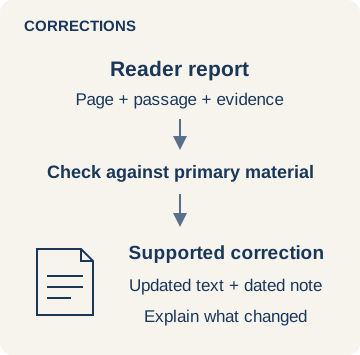
This is the correction standard. A report requires evidence review before an editorial change; it does not guarantee the requested wording.
We check proposed changes against supporting material. A substantive correction should identify the affected claim, explain what changed and carry a correction date. A routine metadata update should record the update date without implying that the talk itself happened later. Preserve the original publication date when revising an article.
The report page provides the correction email link, response targets and the details needed for rights requests. Do not send passwords, private account information or unrelated personal data.
Method and sources
Updated October 2026. This policy retains our sourcing, quotation and independence commitments and clarifies the difference between source verification and human review. It sets the standard readers can use to question a record; it is not an audit of every published page.
For external editorial context, Reuters' standards and values, consulted 18 October 2026, cover named sourcing, quotation context, transparent corrections and accountability for AI-assisted work. That reference does not imply Reuters affiliation or endorsement.
Change note, 18 October 2026: clarified attribution and review disclosures, added correction-request requirements and explained how substantive changes should be recorded. See the methodology for the citation workflow, or report a passage that needs review.