

For organizers: submit an event archive or correction
Send official agendas, session recordings and corrections to OnlineSummit. Use the organizer checklist to identify sources, speakers and usage permissions.
Organizers can submit official event materials or correct an existing OnlineSummit record by emailing info@onlinesummit.com from an official organization address. Start with the exact edition and map each session to its official source. Our editors use that evidence to check the public record; submitting materials does not guarantee coverage or ranking.
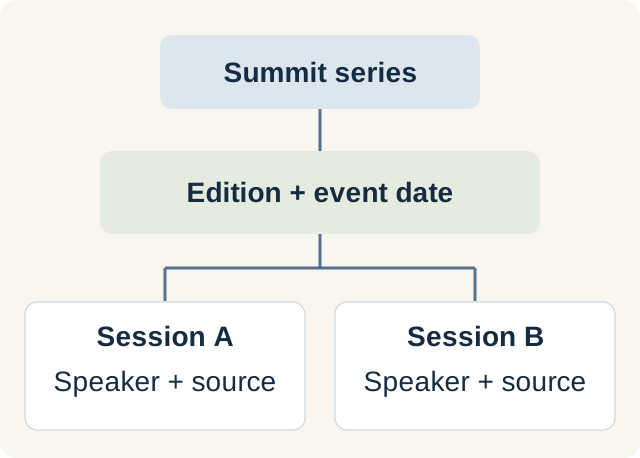
Keep the series, edition and session distinct so editors can match a recording to the right event.
Prepare a submission editors can verify
Send links to official public materials and identify the person responsible for the archive. You can submit an agenda before recordings are available; mark missing materials as unavailable rather than guessing their URLs.
- Give your name, role and organization, plus a public staff or event page that confirms your relationship. If it does not, explain how we can verify it.
- Identify the summit series and edition, with the official event URL, dates, venue and online, in-person or hybrid format.
- Link the agenda and give its timezone. Flag cancellations, rescheduled sessions and title changes.
- For each session, match the title and speakers to the recording, slides or transcript URL. Use the role and organization each speaker held at the event.
- State whether each source is public, restricted or under embargo. Include the embargo date and timezone when relevant.
- Describe permitted use for each asset, who can authorize it and any attribution requirements. Separate permission to link, embed or summarize from permission to reproduce a full file.
This follows our talk sourcing and verification methodology. A series homepage is useful context, but editors also need the session-level source that supports a particular claim.
Map long recordings to individual sessions
For a recording containing several talks, provide each session's start and end on the recording's own clock. A scheduled start time on the agenda cannot locate a passage in a stream that began early or includes breaks. Label a short excerpt as an excerpt and link the full official session if available.
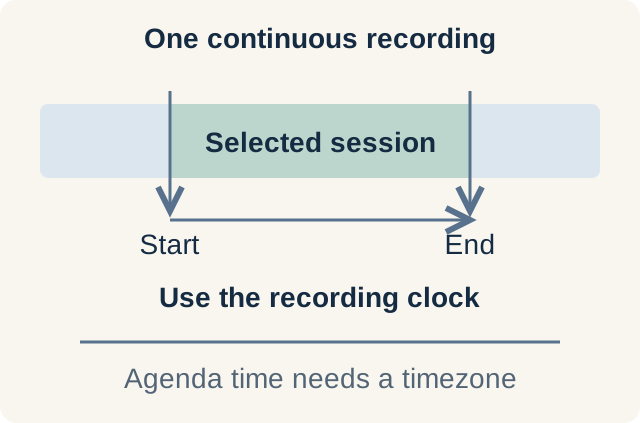
Use source-clock boundaries to locate a session. Supply the event timezone separately for agenda times.
Identify panelists and moderators where several people share a recording. Link official captions or a transcript if available, and tell us whether the text has been checked. W3C's transcript guidance explains that converting captions into a transcript may require adding speaker identification and important visual information. For a correction to a quote or number, point to the exact passage or slide page rather than the playlist alone.
State access and usage limits separately
A source that opens in a browser can still carry restrictions on reuse. For each recording, deck or transcript, describe the intended public use and any limits. Send public source links; do not send passwords, access tokens or attendee lists.
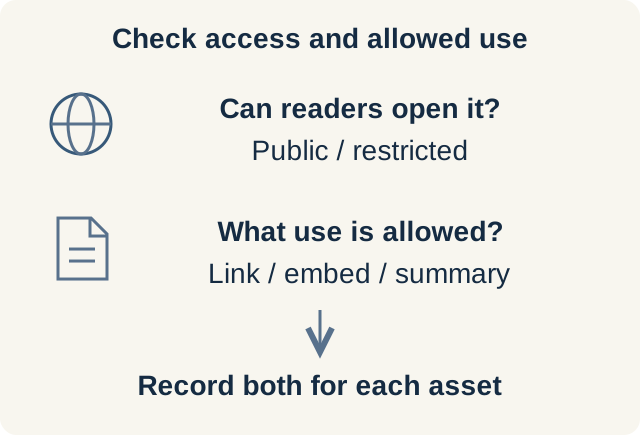
Record access conditions and allowed use separately. One does not establish the other.
An unlisted YouTube URL is shareable: YouTube's privacy guidance says anyone with the link can pass it on. Do not send one as confidential review material. Identify any embargo or permission uncertainty before requesting a public link or embed.
We preserve source URLs and publishers and record retrieval information. We index, summarize and cite official material without bypassing logins or paywalls. We do not publish full transcripts or decks without appropriate permission. If permission is unclear, identify the rights contact and the material in question for editorial review.
Copy this into your email
Use the fields below for a new archive submission or organizer relationship request. Repeat the session fields for each talk you want reviewed; leave unavailable items marked as such.
Subject: [Organizer Claim] OnlineSummit
Your name, role, organization and verification page:
Summit series, edition, official URL, dates and timezone:
Agenda URL and any changes to the published schedule:
Session title, speakers and their event-time affiliations:
Official recording URL and session start/end; slides or transcript URL:
Access status, embargo date/timezone, allowed uses and rights contact:
Existing OnlineSummit page, if this updates a record:
Email the editorial team. Intake currently happens by email; a self-service organizer claim is not available.
Correct a published record
For an incorrect affiliation, misattributed passage or broken source, use the report page. Include the affected OnlineSummit URL, the current wording or value, your proposed correction and an official source with a timestamp or page number where relevant. For a replacement recording, identify which old link it replaces and whether the recording clock has changed.
A current speaker biography may differ from the role held during the event. Explain which date your evidence supports so editors can preserve the historical attribution. For a rights request, identify the specific material and the requested action.
What happens after submission
We acknowledge complete submissions within 3 business days. Editors verify the organizer relationship and official sources before changing public records; straightforward metadata and source updates are normally reviewed within 7 business days. Larger archives are scheduled by edition. These review targets do not guarantee publication.
Organizer confirmation supports the event-level record and does not replace editorial review. Providing material does not purchase favorable summaries, search ranking or featured placement. Read the editorial policy for sourcing and independence rules, and About OnlineSummit for the publication's purpose.
Method and sources
Updated 18 October 2026. This checklist applies OnlineSummit's existing organizer intake, methodology and corrections policies to session-level archive submissions. External references are W3C's transcript guidance (updated 17 September 2024) and YouTube Help's video privacy guidance, checked on 18 October 2026. They explain transcript preparation and link visibility; they do not establish permission to reuse a particular event's materials.