
Public forecasts by frontier lab leaders about when systems matching or exceeding human cognitive capability will arrive, and the mechanisms those forecasts depend on.
Great talks. Insightful articles.
Topics
Browse AI topics to find relevant summit talks. Check each topic’s scope, compare attributed claims and follow the original source before citing.
Search matches topic names. Site search covers talk titles, summaries and indexed claims. For exact wording, check the original recording or transcript.
Start with a topic, finish at the source
A topic helps you find relevant talks across summits. Open a topic, choose a session, then follow its source link and timestamp or page locator to check the passage you need. The topic label alone cannot support a quotation.
Browse talks by summit or year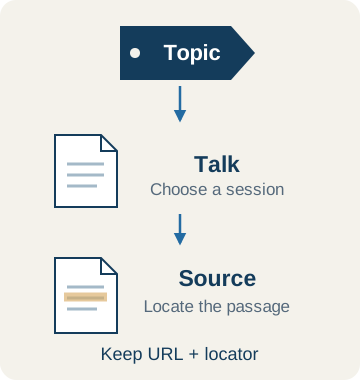
Browse topics with published talks
Topics are grouped by their recorded taxonomy level, not by importance or strength of evidence. Read the definition where available; a blank definition is a reason to inspect the linked talks before assuming the scope.
Level 1
The practice of taking model-based systems from working prototype to production reliability — evaluation, fine-tuning, serving cost and the trade-offs between them.
How legal systems assign responsibility, rights and liability for systems that act without a human deciding each action.
The effect of AI systems on employment, task composition and the structure of entry-level work.
The application of AI systems to scientific discovery — protein structure, weather, materials and drug design — as distinct from general-purpose language capability.
Systems in which language models plan, call tools and carry out multi-step tasks rather than only generating text in response to a prompt.
Network coverage, spectrum and the economics of reaching places terrestrial infrastructure does not serve.
The electricity, grid capacity and siting constraints that determine where AI infrastructure can physically be built.
How organisations measure the output and experience of software teams, and how AI tooling changes what those measures mean.
How large organisations move AI systems from pilot into governed production, including data foundations, access control and operating model changes.
Measuring and improving how consistently model-driven systems produce correct results across repeated runs.
AI systems that perceive and act in the physical world — robotics, autonomous vehicles and the simulation stacks used to train them.
Check the scope before comparing claims
Choose the topic whose definition fits your question. A broad theme can include several different technical or policy questions. Related topics offer another route through the catalogue; their proximity does not establish that the terms mean the same thing.
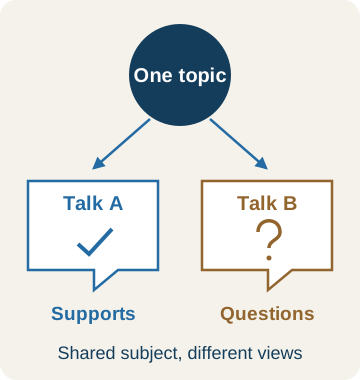
A shared topic label groups discussion; it does not establish agreement among speakers. Read each claim in its session context and retain its type.
- Reported fact or result
- Check the stated evidence, unit and conditions. Attribute a company’s reported result to the speaker or company.
- Opinion or recommendation
- Keep the speaker’s name and reasoning attached. A recommendation does not establish a measured outcome.
- Forecast
- Retain the future date, assumptions and uncertainty given by the speaker. A forecast remains a forecast after it is summarized.
Compare original evidence, not repeated summaries
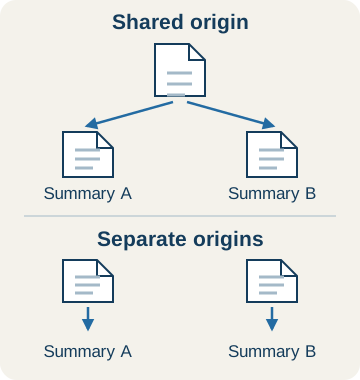
Trace apparently similar claims to their original material. Two summaries that derive from the same recording repeat one origin. Separate source links give you material to compare, but you still need to check whether they rely on the same underlying report or announcement.
For each claim you use, record the speaker, session title, confirmed session date, original source URL and timestamp or page number. Keep the source upload date separate from the session date. Use the talk’s citation controls where available, then check the passage before quoting it.
If the source or locator is missing, look for the organizer’s original recording or document. Until you can locate the passage, describe the record as a lead for further research rather than quoting its summary as the speaker’s exact words.
Method and sources
This guide explains how to use the current topic and talk records. Topic definitions and available claims depend on the material in the catalogue; the directory is not a complete record of everything discussed at an event. The diagrams show reading relationships, not counts or measured agreement.
Read the sourcing and verification methodologyW3C SKOS Primer, section 2.3 (18 August 2009) distinguishes hierarchical and associative concept relations. It informs the scope guidance; it does not certify this catalogue’s taxonomy.
W3C PROV Model Primer, sections 3.6 and 3.4 (30 April 2013) explains derivation and attribution. It informs the source-lineage diagram; provenance alone does not establish a claim’s truth.
Sources consulted 18 October 2026. This update adds directory search and evidence-reading guidance; it does not redate the indexed talks.
For a misplaced topic or unsupported claim, send the record URL, the suggested correction and the original source with its timestamp or page. Include the definition or passage that explains the mismatch.
Report a topic or source correction