

Organizations

NVIDIA

Accelerated-computing company whose GPUs, interconnect and CUDA software stack underpin most current AI training and inference infrastructure.

company / Semiconductors

3
Talks
1
Speakers
3
Editions

Talks

Nadella's Argument: Enterprises Stop Consuming the Frontier and Join It

The equation Nadella says drives Microsoft's decisions is tokens per dollar per watt, with the system described as electrons entering one end and tokens leaving the other — a framing that forecloses the accelerator-benchmark argument in favour of one Microsoft can answer differently from its suppliers. Two claims sit beside each other. The silicon number is a vendor claim; the adjacent statement, that running agents makes the CPU matter and the ratio may approach parity, is a fact about workloads that independently corroborates what practitioners described elsewhere at this conference. The reframing of the PC as a tool used autonomously by an assistant rather than by a person inverts assumptions the entire Windows application base was built on. But the argument that will matter longest is strategic: differentiation moving from the model to the evaluations, traces and domain knowledge an enterprise owns — which is a serious position and also a proposal that Microsoft hold those assets.

Jensen Huang / Microsoft Build

Jensen Huang's GTC 2026 Keynote: Vera Rubin, the Groq Deal and the Inference Inflection

Jensen Huang used NVIDIA's 2026 GTC keynote to argue that AI has crossed an inference inflection: models that once only generated text now reason and act, and each step multiplies the compute a single task consumes. He put NVIDIA's forward demand visibility above one trillion dollars through 2027, then spent much of the keynote explaining why that is a factory-economics claim rather than a chip claim — a gigawatt of AI factory costs roughly forty billion dollars before any compute is installed, so throughput per watt is what determines revenue. The technical centrepiece was the Vera Rubin platform; the strategic surprise was NVIDIA absorbing the Groq team to cover the low-latency decode that NVLink alone cannot reach. He closed on two extensions of the agentic thesis: OpenClaw as an emerging operating system for agents, hardened for enterprises as NemoClaw, and physical AI, where four new robotaxi partners add roughly eighteen million vehicles a year.

Jensen Huang / NVIDIA GTC

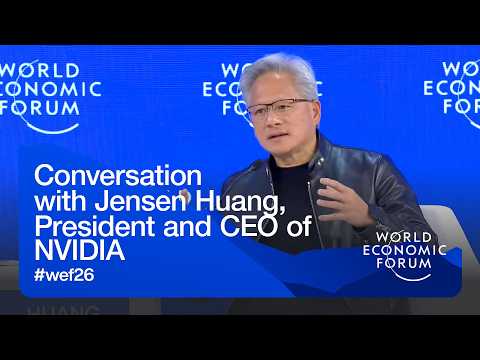
Huang's Five-Layer Cake: The Infrastructure Argument He Took to Davos

Huang brings a diagram to Davos: AI as a five-layer cake running energy, chips, cloud, models, applications — with economic benefit landing at the top and every layer below it a precondition. His argument for why this is a genuine platform shift rather than a product cycle is the strongest part, and it does not rest on his commercial position: software was pre-recorded and worked on structured data, whereas a machine that reasons about unstructured input and inferred intent makes previously impossible applications possible. What the framing accomplishes is worth noticing separately. By presenting the layers as a chain rather than a portfolio, it converts infrastructure spending from a bet into a prerequisite, and the question of proportion between layer-two spending and layer-five value stops being askable. Read against the GTC keynote two months later, the same business gets two framings: one a case for choosing his product, the other a case for the category existing at the scale he needs.

Jensen Huang / World Economic Forum Annual Meeting

How to cite this page

Copy a stable citation for this source-backed profile.