

AI-assisted analysis. See our editorial policy.
Human editorial review not recorded
Demis Hassabis and Dario Amodei disagree about roughly twelve months. Everything else on stage at Davos — the risks, the policy asks, the scepticism about doom, the discomfort with the pace — they hold in common. But the twelve months is not a rounding error, because both men locate the decisive variable in the same place, and their estimates of when it turns are what separates an orderly transition from an emergency.
The variable is whether AI systems can improve AI systems without a human in the loop.
What they actually agree on
It is worth being precise about the shared ground, because it is larger than the framing of the session suggests.
Both expect systems that outperform humans across most cognitive work, and neither treats that as speculative. Both reject the position that the outcome is fixed and catastrophic — Amodei calls himself not a doomer, Hassabis a cautious optimist — while insisting the risks are real enough to organise around. Both want more time than the current competitive dynamic allows. And both name the same mechanism as the accelerant: models good enough at code and at research to compound their own development.
Amodei's version is concrete. Engineers inside his own company, he says, have stopped writing code and now edit what the model produces; he puts the moment when models handle most or all of what a software engineer does end to end at six to twelve months away (1:57). His revenue figures are offered as supporting evidence that capability converts to commercial reality rather than staying in demos — roughly zero to a hundred million dollars in 2023, a hundred million to a billion in 2024, a billion to ten billion in 2025 (6:40).
The disagreement is about which domains resist verification
Hassabis holds to the end of the decade, and his reasoning is not caution for its own sake. It is a claim about where automation stops working.
Coding and mathematics automate early because their outputs are checkable. A program either compiles and passes its tests or it does not; a proof either holds or it does not. Large parts of natural science are not like this. A predicted compound has to be synthesised, a physical prediction has to be measured, and the feedback loop runs at the speed of laboratories rather than of inference.
His sharper objection is about a capability that has not appeared at all. Current systems answer questions; they do not pose them. Forming the hypothesis, choosing the conjecture worth attacking — what he calls the highest level of scientific creativity — is missing, and he is not confident that scaling produces it (3:48). If he is right, the loop closes in the verifiable domains and stalls at the boundary of the rest, which is precisely the shape that yields his slower timeline.
Amodei does not really contest this. He concedes the loop has components AI cannot accelerate — chip fabrication, training runs, the physical supply chain — and frames his own estimate as a guess that things move faster than people expect. The two positions are closer to a shared model with different parameters than to a genuine dispute about mechanism.
Amodei's policy ask is an attempt to escape a trap he describes
The most revealing exchange is not about capability at all.
Amodei says plainly that he would prefer Hassabis's timeline — that five to ten years would be better than one to two. Asked why he does not simply slow down, he gives the honest answer: he cannot, because geopolitical competitors are building the same technology at a similar pace and no enforceable agreement exists to make mutual restraint stable.
His proposal follows from that, and it is worth reading as an attempt to change the structure of the game rather than as trade policy. Halt advanced chip exports, he argues, and the race stops being between countries — at which point it becomes competition between a handful of labs, which he says with evident confidence he and Hassabis could work out between them (23:30). He reaches for a deliberately uncomfortable analogy to reject the counterargument that export access binds a rival into your supply chain (24:21).
Hassabis's ask is different in kind: minimum international safety standards for deployment, on the reasoning that a technology this diffuse will affect everyone regardless of where it is built. Neither man suggests the current environment makes either outcome likely.
On jobs, both of them are careful
The exchange most likely to be quoted out of context is the one where they are most disciplined.
Amodei restates his estimate that half of entry-level white-collar roles could disappear within one to five years, and immediately concedes the labour-market evidence for it has barely begun to appear (16:30). His worry is not that the market cannot adapt — he notes it has absorbed larger transitions — but that a compounding exponential outruns the speed at which adaptation happens.
Hassabis expects the ordinary pattern in the near term: disruption alongside new and possibly better work. His advice to students is unusually specific and does not depend on either timeline being right — become unusually proficient with the tools that already exist, because the capability overhang in current systems is large enough that mastering it may beat a conventional early-career apprenticeship (15:08).
Both then step past the economics. Hassabis's stated concern is not distribution but meaning: whether the institutions that would redistribute abundance exist, and separately whether the sources of purpose that people currently draw from work survive its restructuring. He thinks the second problem is harder than the first.
What to watch
Asked what will have changed by the time they next appear together, both name the same thing without hesitation: whether AI systems building AI systems actually closes the loop (29:47).
That is the useful takeaway from an hour of forecasting. Not the dates, which are estimates offered as estimates, but the agreement about which single observation would settle the question. If the loop closes in the coming year, Amodei's timeline was right and the policy conversation is already late. If it stalls where Hassabis expects — at the boundary of domains where you cannot check the answer quickly — then the additional years exist, and the question becomes whether anyone uses them.
Related appearances by these speakers: Demis Hassabis on AGI by 2030 and AI's Frontiers in Science (Google I/O 2026)
Key numbers
- 6 to 12 months
- Amodei's estimate until models handle most of what a software engineer does end to end 1:57
- $0 → $100M → $1B → $10B
- Anthropic revenue across 2023, 2024 and 2025 as cited by Amodei 6:40
- one to five years
- Amodei's restated estimate for the loss of half of entry-level white-collar roles 16:30
Talk chapters
Key takeaways
- 01
Amodei estimated models are six to twelve months from doing most or all of what a software engineer does end to end, which is the mechanism his whole timeline rests on. 1:57
- 02
Hassabis located the missing capability not in solving problems but in posing them — forming the hypothesis or theory in the first place, which he called the highest level of scientific creativity. 3:48
- 03
Amodei gave Anthropic's revenue as roughly zero to one hundred million dollars in 2023, one hundred million to one billion in 2024, and one billion to ten billion in 2025, as evidence that capability converts to revenue. 6:40
- 04
Amodei framed his forthcoming essay on AI risk around getting through a technological adolescence, deliberately as the counterpart to the optimistic Machines of Loving Grace. 11:31
- 05
Hassabis advised current students to become unusually proficient with existing AI tools, arguing that the capability overhang in today's models may beat a traditional internship. 15:08
- 06
Amodei stood by his estimate that half of entry-level white-collar jobs could disappear within one to five years, while conceding the labour-market evidence for it has barely begun to appear. 16:30
- 07
Amodei argued that halting chip sales would convert a US-China race into ordinary competition between labs, and compared the export rationale to selling weapons abroad for the sake of a domestic manufacturer's profit. 24:21
- 08
Both named the same thing to watch over the coming year: whether AI systems building AI systems actually closes the loop, which decides whether the remaining timeline is a few years or much shorter. 29:47
Entities mentioned
Related talks

Four months after Davos, Hassabis put a sharper number on the same forecast: AGI around 2030, give or take a year, arriving gradually rather than as a single moment. His test for it is concrete — a model with a 1901 knowledge cutoff that could produce Einstein's 1905 insights — and by that standard current systems plainly fail. The interview is more useful than the Davos panel on two fronts. First, competitive position: he argues Google's advantage is being the only organisation holding the full stack from chips to billion-user products, citing 900 million monthly users on the Gemini app. Second, method: the AlphaFold story of choosing to fold every known protein at once rather than run a request service is his working example of what acceleration should look like. He closes on a warning aimed at the Bay Area — that direction matters more than velocity, and that the current frenetic pace is not conducive to the deep work the next advances require.
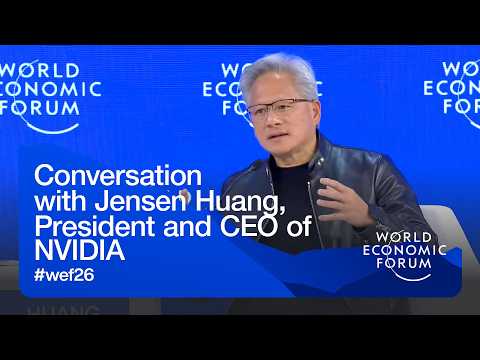
Huang brings a diagram to Davos: AI as a five-layer cake running energy, chips, cloud, models, applications — with economic benefit landing at the top and every layer below it a precondition. His argument for why this is a genuine platform shift rather than a product cycle is the strongest part, and it does not rest on his commercial position: software was pre-recorded and worked on structured data, whereas a machine that reasons about unstructured input and inferred intent makes previously impossible applications possible. What the framing accomplishes is worth noticing separately. By presenting the layers as a chain rather than a portfolio, it converts infrastructure spending from a bet into a prerequisite, and the question of proportion between layer-two spending and layer-five value stops being askable. Read against the GTC keynote two months later, the same business gets two framings: one a case for choosing his product, the other a case for the category existing at the scale he needs.

Harari spends most of his address establishing terms before asking the question he came to ask. His preliminary work is to dismantle the word tool: a knife's use is decided by whoever holds it, whereas what is arriving decides for itself, and can also invent new kinds of knives. From there he argues that anything constituted by words — law, books, text-centred religion — is exposed, while drawing a firm line at feeling, where he says there is no evidence at all. The structural claim is that the ancient tension between letter and spirit has always run inside humanity and is about to be externalised between humans and the new masters of words. Only then does he arrive at personhood, and his handling is precise: corporations, New Zealand rivers and Indian deities hold legal personhood safely because the decisions are made by humans behind the container. An entity that decides for itself ends that arrangement. He does not answer the question; he tells the room it is coming.

A show of hands opens the session: nearly everyone has piloted, far fewer have scaled, and everyone who scaled hit problems they did not anticipate. What makes the panel useful is where the four answers do not point. None of the executives — running a healthcare manufacturer, a payments network, an energy producer and a consultancy — blames model capability, cost or data infrastructure. All four describe an organisational constraint. McInerney's account is the sharpest and is an account of failure: eighteen months of executive advocacy and democratised model access produced nothing, until three hundred senior leaders were put in a room for two days and made to build agents themselves. Jakobs supplies the mechanism worth copying, measuring returned clinician time against the three to seven minutes a patient currently receives rather than against cost. Nasser rejects the premise that acquiring compute produces value, and locates returns in operations rather than in the back-office functions most organisations automate first.

The distinction in this session that deserves to travel is a two-word change: the model is moving from an attention economy to an attachment economy. That changes what is measured and what regulation would have to address, because attention competes for time while attachment competes for relationship, and the two produce different products from identical technology. Attention is finite in a way people notice; attachment produces reliance that feels like preference, which makes it harder to regulate for the same reason it is harder to notice. The supporting argument is about incentives rather than intent: earlier engagement produces more data and longer relationships. The regulatory proposal — measuring well-being outcomes rather than asking for safety by design — identifies the right target without solving the measurement problem that made regulators settle for a floor in the first place.

The most useful sentence is a diagnosis of how clients are getting it wrong: they see a cost opportunity rather than a revenue one. That framing decides everything downstream, because an organisation treating AI as cost reduction measures success by what disappears and arrives at a smaller version of what it already was. The market number offered — seventeen per cent index growth in 2025 that nobody foresaw — is deployed against bubble anxiety and argues in both directions, since unforecast gains are poor evidence for confidence in any current consensus. The panel then locates the real source of instability outside technology entirely, in three geopolitical situations generating enough uncertainty to dominate planning, which is a corrective worth taking seriously at a technology conference. Their closing question about thriving across multiple futures is correct and sits uneasily beside the cost framing they diagnosed at the start.